
Description
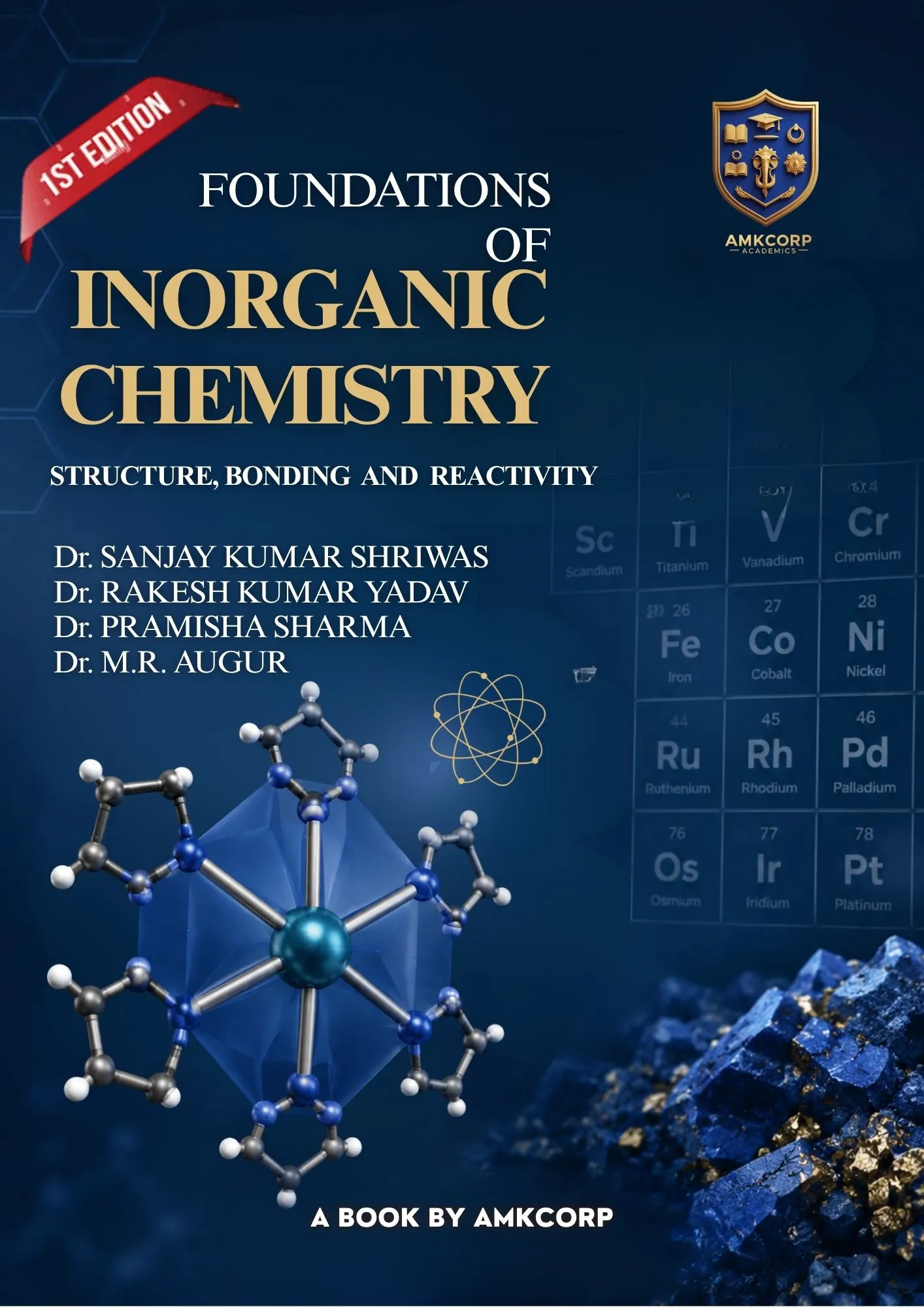
Foundations of Inorganic Chemistry: Structure, Bonding, and Reactivity is a comprehensive and academically enriched textbook designed to provide students, researchers, and educators with a strong conceptual understanding of inorganic chemistry and its modern applications. The book systematically explores the fundamental principles governing the structure, properties, bonding, and reactivity of inorganic substances, while also connecting classical theories with contemporary developments in chemistry and material science. Written in a clear and student-friendly manner, this book serves as an essential resource for undergraduate and postgraduate learners pursuing chemistry, pharmaceutical sciences, biotechnology, materials science, and related disciplines.
Beginning with the historical evolution and scope of inorganic chemistry, the book introduces readers to the core concepts that form the backbone of the subject. It explains atomic structure, quantum theory, periodic trends, and electronic configurations in a logical sequence that helps readers build a strong theoretical foundation. Detailed discussions on chemical bonding, molecular geometry, hybridization, and molecular orbital theory enable students to understand how atoms interact and form stable compounds with distinct physical and chemical properties.
The text further advances into important areas such as symmetry and group theory, coordination chemistry, solid-state chemistry, acid-base theories, and non-aqueous solvents. These chapters are carefully structured to explain complex concepts through simplified descriptions and practical examples, making advanced inorganic chemistry more accessible to learners. Special emphasis is placed on crystal field theory, ligand field theory, molecular symmetry, and spectroscopic applications, which are crucial for understanding modern inorganic systems and analytical techniques.
In addition to theoretical aspects, the book extensively covers the chemistry of main group elements, transition metals, lanthanides, actinides, and organometallic compounds. Readers gain insight into the diverse chemical behavior, industrial importance, catalytic applications, and biological significance of inorganic compounds. The inclusion of bioinorganic chemistry highlights the role of metals in living systems, metalloproteins, and biochemical processes, bridging the gap between inorganic chemistry and biological sciences.
A distinguishing feature of this book is its balanced approach between foundational knowledge and real-world applications. Topics such as catalysis, industrial materials, magnetic and electrical properties of solids, and emerging trends in inorganic chemistry provide readers with a modern perspective on how inorganic chemistry contributes to technology, medicine, environmental science, and advanced materials research.
Carefully organized and pedagogically structured, the book encourages analytical thinking, conceptual clarity, and scientific curiosity. Each chapter is designed to guide learners progressively from basic principles to advanced applications, making the text suitable for classroom teaching, competitive examinations, self-study, and research preparation. Overall, Foundations of Inorganic Chemistry: Structure, Bonding, and Reactivity serves as a valuable academic companion for anyone seeking a thorough and practical understanding of inorganic chemistry in both traditional and modern scientific contexts.

Reviews
There are no reviews yet.