

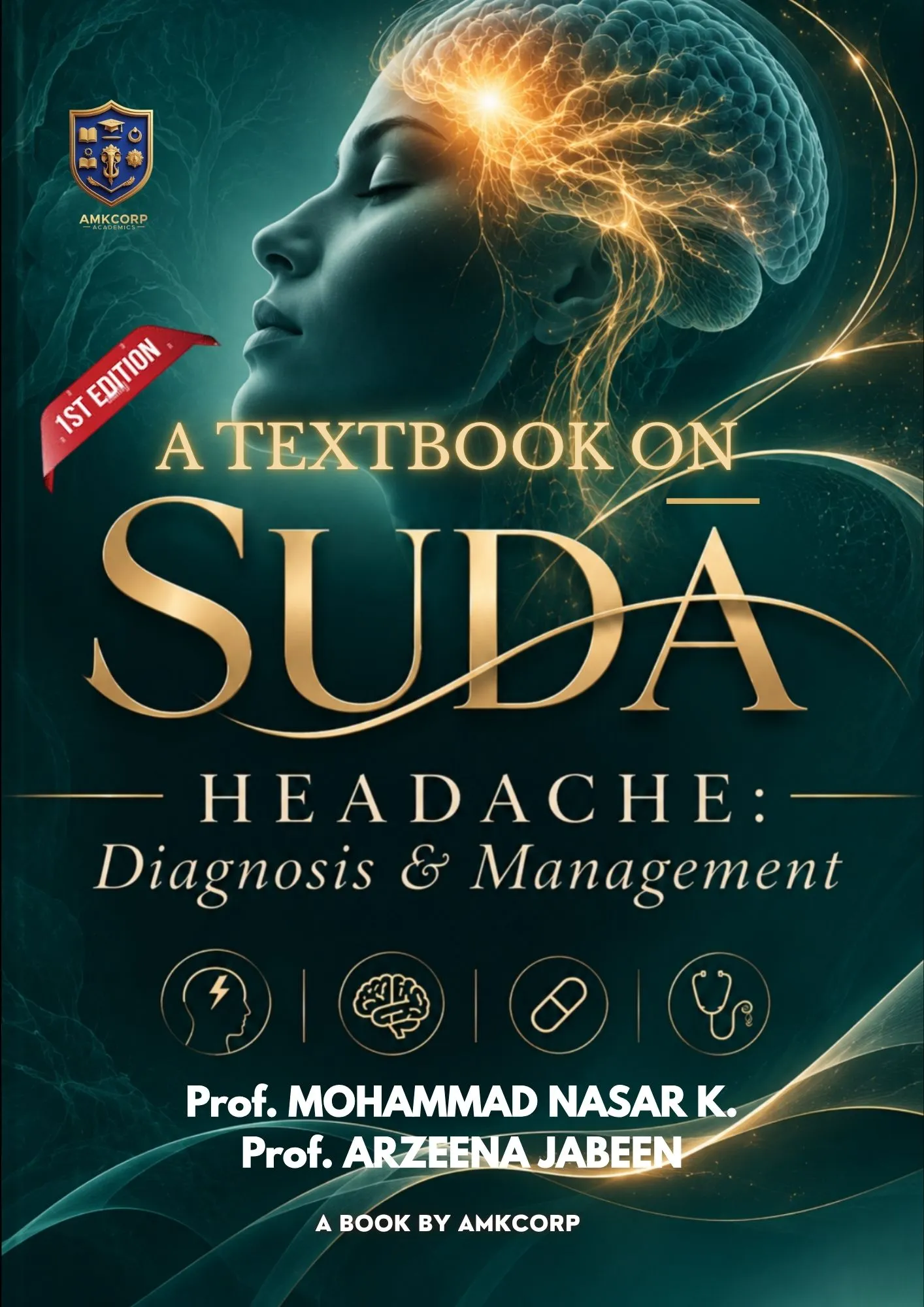
Description
Sudāʿ (Headache) – Diagnosis & Management is a comprehensive and student-oriented textbook that presents the concept of headache from the classical perspective of Unani medicine, with systematic attention to its causes, classification, clinical features, diagnosis, differential diagnosis, principles of treatment, management, and prognosis. The book is designed to provide readers with a structured understanding of Sudāʿ as a clinical condition while highlighting the fundamental Unani concepts of Mizāj (temperament), Akhlāṭ (humours), Mādda (morbid matter), Dimāgh (brain), and Quwwat (faculties).
The textbook begins with the fundamental understanding of the Dimāgh (brain) and its role as one of the principal organs of the body. It explains the importance of the normal Mizāj of the brain, described in Unani medicine as Bārid Ratb (cold and moist), and discusses how disturbances in temperament and humoural equilibrium may contribute to the development of headache. The role of the four Akhlāṭ—Dam (blood), Balgham (phlegm), Ṣafrāʾ (yellow bile), and Sawdāʾ (black bile) is explored in relation to the development and clinical expression of Sudāʿ.
A major strength of the book is its systematic classification of Sudāʿ. Rather than treating headache as a single clinical entity, the textbook presents multiple classifications based on Mizāj, Akhlāṭ, Mādda, site of origin, referred origin, inflammation, and other clinical characteristics. The major categories include Sudāʿ Ḥārr, Bārid, Yābis, Ratb, Damwī, Ṣafrāwī, Balghamī, Saudāwī, Maddī, Ghair-Maddī, Dimāghī, Ghishāʾī, Aʿṣabī, Shirkī, Waramī, Ghair Waramī, Laylī, Subāʾī, Ḥādd, Muzmin, Rīḥī, Ḍuʿf-e-Dimāghī, Ḥissī, Shamsī, Shammī, and Jimāʿī.
Each major type of headache is discussed through a consistent clinical framework, making the material easier to study, revise, and apply. Depending upon the type, the discussion covers Ibtidāʾī Taʿāruf (Introduction), Taʿrīf (Definition), Asbāb (Etiology), Takwīn-e-Marad (Pathophysiology), ʿAlāmāt-wa-Āthār (Signs and Symptoms), Tashkhīs (Diagnosis), Tashkhīs-e-Imtiyāzī (Differential Diagnosis), Uṣūl-e-Ilāj (Principles of Treatment), Ilāj (Treatment), and Anjām-e-Marad (Prognosis). The use of tables, comparative descriptions, and treatment flowcharts further supports conceptual understanding and quick revision.
The diagnostic approach presented in the textbook gives importance to the clinical character of pain, its onset, duration, location, associated manifestations, aggravating and relieving factors, Mizāj assessment, humoural involvement, and relevant clinical observations. The book repeatedly emphasizes that correct identification of the underlying type and cause of Sudāʿ is essential before selecting an appropriate therapeutic approach. This etiological and individualized approach reflects the fundamental philosophy of Unani medicine.
Particular attention is given to Tashkhīs-e-Imtiyāzī (Differential Diagnosis). The concluding section specifically brings together the differential diagnosis of different types of Sudāʿ, highlighting the importance of distinguishing between different headache patterns and identifying possible underlying conditions. This section reinforces the importance of appropriate clinical assessment and helps readers understand why different types of headache require different approaches to management.
The therapeutic section of the book is organized around the classical Unani Uṣūl-e-Ilāj (principles of treatment). These include approaches such as Taʿdīl-e-Mizāj (correction of temperament), Tanqiya-e-Mādda (evacuation of morbid matter), Taqwiyat-e-Dimāgh (strengthening of the brain), Izāla-e-Sabab (removal of the cause), and Taskeen-e-Dard (relief of pain). Treatment is discussed through the major Unani modalities of Ilāj-bil-Tadbīr (Regimental Therapy), Ilāj-bil-Ghidhā (Dietotherapy), and Ilāj-bil-Dawā (Pharmacotherapy).
The book also discusses Advia Mufrada (single drugs) and Murakkabāt (compound formulations) within the treatment of different headache types, along with relevant dietary, regimental, and lifestyle considerations. Treatment flowcharts are incorporated at various stages to present the therapeutic sequence in a clear and practical manner. These features make the textbook useful not only for theoretical study but also as a structured reference during clinical learning.
Another important feature of the textbook is its emphasis on individualized management. Different headache types are approached according to their underlying Mizāj, humoural involvement, causative factors, clinical presentation, and associated conditions. For example, the management principles for Sudāʿ Ḥārr focus on addressing excessive heat and relevant causative factors, whereas Sudāʿ Bārid is approached through principles directed toward correcting excessive coldness and moisture and restoring appropriate functional balance.
The book therefore provides an integrated presentation of classical Unani theory and clinical reasoning. It moves progressively from foundational concepts of the brain, temperament, and humours to the definition and classification of Sudāʿ, followed by detailed discussions of individual types, their clinical identification, differential diagnosis, treatment principles, therapeutic approaches, and prognosis. This logical progression allows readers to develop a coherent understanding of headache rather than studying individual types in isolation.
With its structured chapters, extensive classification, clinical descriptions, diagnostic framework, differential diagnosis, treatment principles, therapeutic modalities, and flowcharts, Sudāʿ (Headache) – Diagnosis & Management is intended to serve as a useful academic and practical reference for students, teachers, researchers, and practitioners of Unani medicine. It is particularly suitable for learners seeking to strengthen their conceptual understanding of Sudāʿ and develop a systematic approach to its diagnosis and management according to classical Unani principles.
Ultimately, this textbook seeks to present Sudāʿ not merely as a symptom of head pain, but as a clinically diverse condition requiring careful assessment of temperament, humoral involvement, causative factors, affected structures, and individual presentation. By bringing these elements together in a clear and organized format, the book provides a focused academic resource for understanding the Unani approach to the diagnosis and management of headache.




Reviews
There are no reviews yet.